

How The Dry Cleaning Pick Up And Delivery Works
What Is Dry Cleaning?
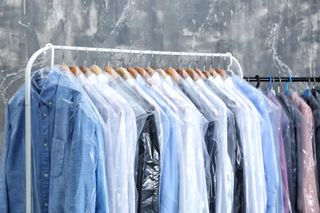
Despite the proper name, dry cleaning is a procedure that uses liquids other than h2o to clean wearing apparel, bedding, upholstery and other types of fabrics. H2o can impairment certain fabrics — such equally wool, leather and silk — and a washing machine can wreak havoc on buttons, lace, sequins and other delicate decorations. Enter dry out cleaning.
Dry cleaning chemicals
Dry out cleaners use a diverseness of solvents to make clean fabric. Early solvents included gasoline, kerosene, benzene, turpentine and petroleum, which were very combustible and dangerous, according to the Land Coalition for Remediation of Drycleaners (SCRD), a group whose members share information almost cleanup programs. The 1930s saw the development of synthetic, nonflammable solvents — such as perchloroethylene (also known every bit perc or PCE) and decamethylcyclopentasiloxane (also known as GreenEarth) — which are still used today.
Detergents are typically added to the solvents to help in the removal of soils, according to an SCRD report titled "Chemicals Used in Drycleaning Operations." Detergents aid dry cleaning in three ways:
- Carrying wet to aid in the removal of h2o-soluble soils.
- Suspending soil afterward information technology has been removed from the fabric so it won't exist reabsorbed.
- Acting as a spotting agent to penetrate the cloth and then that the solvents will be able to remove the stains.
Detergents are either added into the solvent before dry cleaning begins or added into the procedure at specific times.
Dry cleaning process
Dry out cleaning machines consist of 4 parts, according to the Drycleaning & Laundry Institute (DLI), an international trade clan for garment care professionals:
- The holding tank or base tank that holds the solvent.
- A pump that circulates the solvent through the automobile.
- Filters that trap solid impurities and soils removed from either the solvent or the fabric.
- A cylinder or bicycle where the items that are beingness cleaned are placed.
During dry cleaning, the pump pulls solvent from the tank and sends it through the filters to remove any impurities. The filtered solvent so enters the cylinder, where it interacts with the fabrics and removes any soil. The solvent so travels dorsum into the holding tank so it can begin the process once more.
After the items consummate the cleaning wheel, the machine goes through an extraction cycle, which removes backlog solvent. During this process, the rotation rate of the cylinder increases, much similar the concluding spin bicycle on a home washing machine.
After the extraction cycle completes and the cylinder stops moving, the clothes are either dried within the same machine (if it is a closed organisation) or transferred into a separate drier. The excess solvent is collected, filtered and transferred back into the holding tank.
History of dry out cleaning
Dry cleaning dates back to ancient times, according to the DLI. Records about methods for cleaning delicate items have been found in the ruins of Pompeii, decimated by the eruption of Mount Vesuvius in the year 79. In those days, many wearing apparel were made from wool, which was known to shrink in h2o. Professional wearing apparel cleaners, known equally fullers, used solvents such as ammonia (produced from urine) and lye, as well as a type of dirt chosen fuller's globe, which excelled at absorbing dirt, sweat and grease stains.
Co-ordinate to the DLI, the primeval reference to anything resembling modern dry cleaning was a story almost a clumsy maid who spilled some kerosene on a greasy tablecloth. The kerosene chop-chop evaporated, and she noticed how much cleaner the spot where the chemical fell was. People performed many experiments after that incident to determine what types of solvents were best at cleaning greasy stains. These substances included turpentine spirits, kerosene, petroleum-based fluids, gasoline and camphor oil, according to the SCRD.
The credit for being the first commercial dry cleaner goes to the firm of Jolly-Belin, which opened in 1825 in Paris, co-ordinate to the Handbook of Solvents. In Paris, of grade, fashion was an important role of guild. The clothes were soaked in vats filled with turpentine, and so put into a sort of predecessor to the washing machine and so air dried and so that the turpentine could evaporate.
The first dry out cleaner in the United States showed up around the same fourth dimension. Thomas Jennings, a U.S. tailor and inventor, as well as the first known African-American to receive a patent in the United States, used a method called "dry scouring" to clean clothes that traditional cleaning methods would damage. His process was patented in 1821, and Jennings ran a highly successful tailoring and dry cleaning business concern in New York Metropolis.
The underlying issue with petroleum-based solvents was their extreme flammability, so alternatives were sought. Michael Faraday, an English language physicist and chemist, first synthesized PCE in 1821. Withal, information technology wasn't readily used in dry out cleaning until the early 1930s, after William Joseph Stoddard, a U.Southward. dry out cleaner, further adult PCE as a dry cleaning solvent. Its apply grew in the late 1930s and early on 1940s due to a petroleum shortage during World State of war II.
Environmental and wellness concerns
While it is the most popular choice for dry cleaning, perchloroethylene has been constitute to be dangerous for both health and the environment. Co-ordinate to the Occupational Safety & Health Administration (OSHA), coming into contact with perc puts dry out cleaning employees at high risk of wellness complications. Exposure to perc vapors may occur when an employee loads dirty dress into a machine, removes items before the drying cycle completes, cleans lint or button traps, changes the filters, or performs maintenance on the machines.
Those who have their dress and uniforms dry out cleaned regularly may too experience the side effects of perc. Inhaling these vapors for a prolonged period tin cause dizziness, drowsiness, loss of coordination, balmy memory loss, visual perception and baking of the skin after prolonged contact.
People in the dry cleaning business also confront a risk of certain types of cancer. Long-term exposure, according to the National Library of Medicine, may lead to certain types of cancer, including esophageal, cervical, bladder, multiple myeloma and non-Hodgkin's lymphoma. There are also potential links to cervical and chest cancers.
Damage to the central nervous organisation, liver, kidneys and lungs may besides develop.
Studies, such equally one published in 2022 in the journal Environmental Health Perspectives, discuss links that have been found between perc and cancer, particularly in the dry cleaning business organisation. Subsequently going over many similar past studies, and after studying the effects of perc on rats, the researchers in the 2022 study concluded that perc exposure did have a strong correlation with certain types of cancer. Like to the EPA's 2022 nomenclature, the 2022 study characterized the substance as "likely to exist carcinogenic to humans," no matter how someone came in contact with the chemical.
Another 2022 study, also appearing in Environmental Health Perspectives, specifically examined the risk of bladder cancer in people exposed to perc. The researchers besides found strong correlations betwixt dry cleaners who apply perc every bit a solvent and an increased risk of bladder cancer. This held truthful even after taking into account cigarette smoking, another known hazard factor in the development of float cancer.
The EPA too stated that there is some show, while inconclusive, that perc affects the reproductive arrangement in both men and women, resulting in altered sperm structures and reduced fertility. At that place has also been some research into birth defects caused by perc, but the studies are few and have many limitations.
Perc can be released into the air, h2o and soil in the environs around where it is produced or used, including the neighborhood dry cleaner. Co-ordinate to the Bureau for Toxic Substances and Illness Registry, most of the perc in the atmosphere comes from the dry cleaning manufacture. The compound breaks down very slowly in the temper, and then it can travel long distances.
Perc can enter the water organisation by liquid waste that may exist contaminated with the solvent. Typically, most of the perc evaporates rapidly from the water, and the leftovers break down slowly in the water. The chemical besides breaks downwards slowly in soil, where it concentrates after seeping out at waste product-disposal sites.
The time to come of dry cleaning
Today, there are at least 36,000 dry cleaners in the United States solitary, according to IBISWorld, a market place-research company. Nevertheless, according to several sources, including a story published on American Drycleaner, many areas in the United States are losing dry cleaners. The article indicates that rising rents, coincidental attire becoming the new norm, more-durable fabrics being used for clothing and cheap clothing are just a few of the reasons for the shrinking number of dry cleaning stores in the United States.
Another reason is that many dry cleaners are small-scale, family unit-owned businesses. As the older generation retires, the younger generation looks for other types of jobs. Environmental concerns are as well irresolute the industry. California, for example, is phasing out the utilise of perc in dry cleaning in favor of less-toxic choices, including h2o-based and carbon dioxide cleaning.

Since loftier school, Rachel Ross has been looking upwardly toward the stars to empathize how the universe works. She has an undergraduate caste from the University of California Davis and a master's degree in astronomy from James Cook University. Rachel has spent several years making her passion for astronomy and science education into a profession. She has fifty-fifty held the position of Jedi master at an observatory. And no matter what everyone says, the final answer is always 42 and duct tape is useful in all situations.

Source: https://www.livescience.com/63089-dry-cleaning.html
Posted by: negronforstand.blogspot.com
0 Response to "How The Dry Cleaning Pick Up And Delivery Works"
Post a Comment