

How To Create A Window In Revit
Most Windows
Windows tin can be added in plan, meridian, section or a 3D view. Windows are loadable families, which means that the family unit of the Window (sizes, shapes, design) tin can be customized and placed in the library to load them in your project.
Windows are dependent elements on their host which is usually a wall. Like in real life, a window cannot be placed if there is no wall on site. Similarly, in Revit, a Window cannot be placed without a wall.
Tutorial Objective:
Modeling windows is similar to modeling doors. Thus, information technology is recommended that you familiarize yourself with tools and techniques shown in the chapter Modeling Doors earlier starting this tutorial.
In this tutorial, you volition learn,
- To load a family into the projection
- To customize the window sizes and create new window types
- To place a window in the project
- To add together Window Tags on your drawing
Sample Problem:
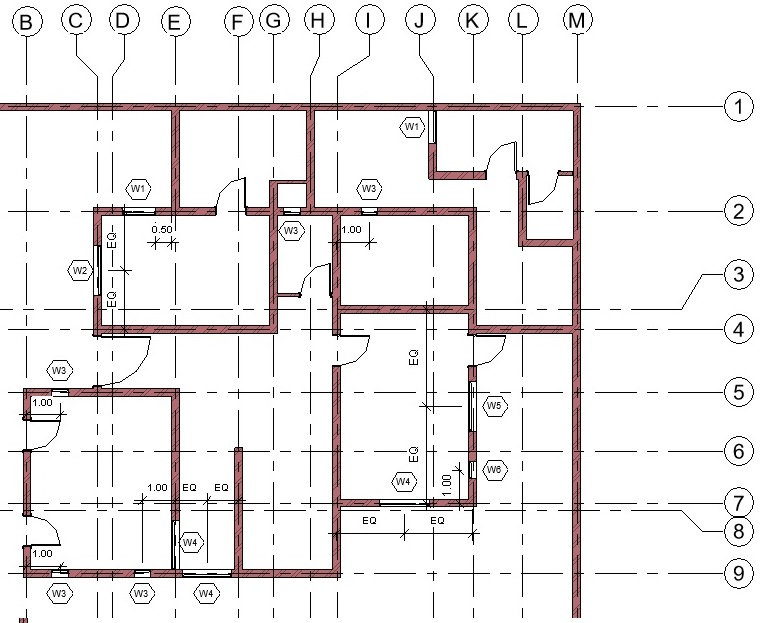
- Add windows of following types in the Ground Flooring layout equally shown beneath:
- W1: one.0 x 1.0 1000 (Lintel Superlative: 2.13m)
- W2: 1.5 x 1.0 m (Lintel Tiptop: 2.13m)
- W3: 0.v x 2.0 chiliad (Lintel Height: 2.13m)
- W4: 1.5 x two.0 thou (Lintel Tiptop: 2.13m)
- W5: 1.5 x 0.5 m (Lintel Summit 1.6m)
- W6: 0.5 x 0.v m (Lintel Top i.6m)
Sample Files required for this tutorial:
If you do not take the post-obit files, please download them from here.
- "TutorialWindows_Input_LearningRevitOnline.rvt"
- Window Family file: "Window_Single Panel.rfa"
- Window Tag Family file: "Window_Type Tag.rfa"
Solution:
- Open 'TutorialWindows_Input_LearningRevitOnline.rvt' in Revit. This project file already contains doors modeled in the Basis Flooring levels.
- Navigate to the floor plan of "00 Footing Level".
- Windows are loadable families which means nosotros will showtime need to load the family of the window from the library (if information technology is not already loaded in your project).
-
To load a family unit into the project:
- Click Insert tab -> Load from Library panel -> Load Family
- Navigate to the folder where you take downloaded and saved the Window_Single Panel.rfa (If you do not accept this file all the same, please download information technology from here).
- Note:By default, Revit volition navigate to the library where default Autodesk families are stored. If yous do not find this path when yous need it, endeavour to locate it on your PC at : %ALLUSERSPROFILE%\Autodesk\RVT 2019\Libraries (If yous cannot still find the location of your family library, please see this Video Tutorial: Locating your family folder )
- Select the file and Click Open.
- The family has been loaded into the project.
- Now, earlier we add the windows into our model, we must create the Window types with the specific sizes as required for our project.
-
To customize the window sizes and create new window types:
- Click Architecture tab -> Build console -> Window
- Alternatively, utilize "WN"as keyboard shortcut.
- From the type selector, select whatsoever of the types available for Window_Single Console family.
- From the properties, select Edit Type to access Blazon properties palette.
- Click Duplicate to create a new Window Type. In the Name dialog box, requite a new name to the window blazon "W1_1.0 10 1.0"
- Click Ok to the Name dialog box.
- Now, change the parameters Width to 1.0m value and Height to 1.0m value.
- Click OK to the Type Properties dialog box.
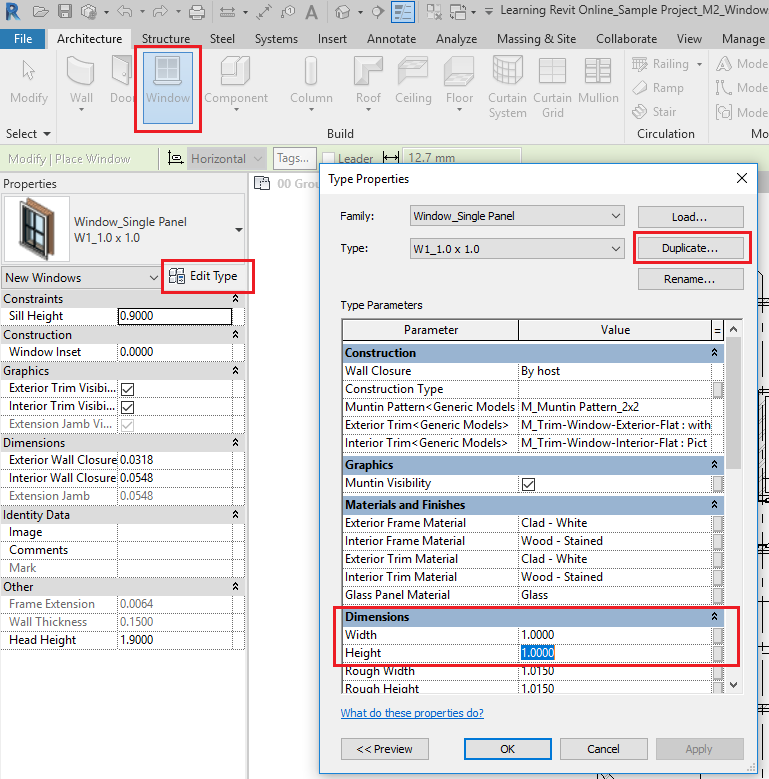
- A new window type has been created.
- Click Esc to end the Window tool.
- Click Architecture tab -> Build console -> Window
- Repeat step 6 to create following window types:
- W2_1.5 x 1.0 (width = 1.5m, height = 1.0m )
- W3_0.v x 2.0 (width = 0.5m, height = 2.0m )
- W4_1.5 x 2.0 (width = i.5m, meridian = 2.0m )
- W5_1.5 x 0.5 (width = one.5m, peak = 0.5m )
- W6_0.5 x 0.5 (width = 0.5m, height = 0.5m )
- Now, as all the window types required are prepared, we can begin to identify windows in the model.
-
To place a window in the project:
- Click Compages tab -> Build panel -> Window
- Alternatively, use "WN"as keyboard shortcut.
- Select the Window type W1_1.0 ten 1.0 from the type selector.
- Select the window. In the Instance properties, there is parameter known every bit "Caput Summit". This parameter value control the lintel height of the window. Alter the value of head height to 2.13m (Note that when you change the value of the Head height, Sill height parameter volition change automatically based on the Height of the window selected).
- In the drawing area, click on the wall where y'all would similar to place the window (between Filigree D2-E2 as shown below). Practise non worry most accurate position at the moment. You tin can adjust it after yous have placed the window.

- TIP: Printing the Spacebar to flip the window while placing it in plan view.
- Click Esc twice to terminate the Window tool.
- Note that later placing the window, Revit has made an advisable opening in the wall automatically.
- Click Compages tab -> Build panel -> Window
- Select the window you have placed.
- Temporary dimensions volition appear. If they do not appear, click on "Activate Dimensions" on the options bar.
- TIP:You tin can also utilise a permanent dimension (Annotate->Dimension->Aligned Dimension) instead. Select the window and the permanent dimension volition be editable. If it is not editable, select Actuate Dimensions to brand it editable.
-

- Modify the value of the temporary dimension to 0.5m from the right edge of the window to the face of the wall on Grid E as shown to a higher place. Apply the Witness line controls (blue dots on the temporary dimensions) to adjust the reference of the dimension, if needed.
- TIP: Alternatively, y'all tin can besides place a permanent dimension between the window and the wall. Select the window afterward placing the dimension and change the value of the dimension. (If the dimension is not-editable, click on Activate Dimensions to activate it).
- Now, let's place another instance of the W1_1.0 x 1.0
- Repeat step 9 to place the window at Filigree J as shown below.

- Using the Align tool (Modify tab -> Modify console -> Marshal), align the edge of the left confront of the window to the inner face of the wall every bit shown below.

- Repeat Step nine to add other windows as shown in Fig 1. Ensure that the head meridian for windows is 2.13m for window type W1, W2, W3, W4 and 1.60m for window type W5 and W6.
- Use tools such as Align and Move to position the windows correctly. You may also employ temporary, permanent dimensions and equality constraints to position the windows at a specific distance from other elements. Learn more almost these tools in the affiliate Modeling Doors
- At present, after modeling all windows, navigate to a 3D view to meet all the windows in 3D.

- Afterwards adding all the windows, let's at present add together annotation of the window blazon numbers equally window tags in the drawing as shown in Fig 1.
-
To Add Window Tags on your drawing:
- After completing all the steps above, Save As your project every bit "TutorialWindows_Output_LearningRevitOnline.rvt".
More References:
- Learn more about why sometimes temporary dimensions are not displayed in Revit.
- After placing the window, if yous would like to move it to another wall, use 'choice new host' tool to move the window.
- Video Tutorial: Create a custom tag presented by josukke
- If your projection requires a dissimilar numbering system or if you wish to customize window tags as per your project specifications, you tin create your own custom window tag family unit.
- Video Tutorial: How to create a window family presented by SmarterArchitect.
- If you would like to create your ain custom family for the window, information technology is advised that yous first familiarize yourself with basic family editing tools covered in later sections of this grade. Nonetheless, if you are already familiar with them, you tin can create a custom window as guided by this tutorial.
Source: https://learningrevitonline.com/2018/10/27/tutorial-windows/
Posted by: negronforstand.blogspot.com
0 Response to "How To Create A Window In Revit"
Post a Comment